
NEWS
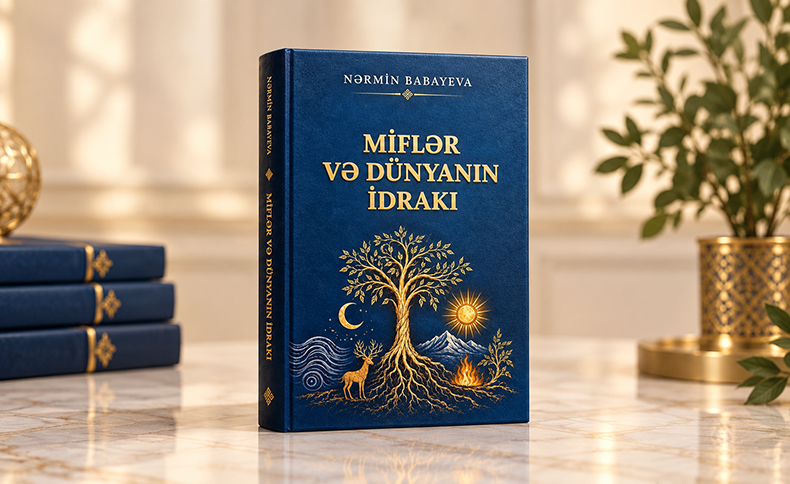
Monograph by Narmin Babayeva about the semantics of Azerbaijani etiological myths was published
A monograph entitled “Myths and the Cognition of the World” by PhD Narmin Babayeva, a research fellow at the Department of Mythology of the Institute of Folklore of the Azerbaijan National Academy of Sciences (ANAS), has been published by publishing house “Elm ve tehsil”.
The 232-page monograph was published by the decision of the Scientific Council of the Institute of Folklore of ANAS. The scientific editor of the book is Doctor of Sciences in Philology, Professor Seyfaddin Rzasoy, the reviewers are Doctor of Sciences in Philology, Associate Professor Galib Sayilov and Doctor of Sciences in Philology, Associate Professor Shakir Albalıyev.
The monograph consists of the introductory sections “From the Editor” and “Foreword”, three main chapters, “Conclusion” and “List of literatures”. The first chapter is called “The Etiological Myth, Its Place in the Classification System of Myths and Its Relation to the Cosmogonic Myth”, the second chapter is called “Etiological Myths Concerning the Emergence of Images of the Real-Physical World” and the third chapter is called “Etiological Myths Concerning the Emergence of Images of the Metaphysical World and Time”.
The study focuses on the semantics of etiological myths, which have not previously been systematically investigated as a distinct monographic research problem in Azerbaijani folklore studies. The author identifies the principles for distinguishing etiological myths from other thematic groups of myths, as well as their place within the system of mythological texts and their theoretical nature.
The study substantiates the view that etiological myths constitute an independent thematic group within the corpus of Azerbaijani mythological texts and possess distinctive semantic features. At the same time, it identifies the functional semantics of etiological myths, examines their common and differing features in relation to cosmogonic myths, and explores the place of etiological thinking in the Oghuz epic-mythological tradition.
The monograph is intended for folklorists, mythologists, ethnographers, philologists, historians, cultural studies scholars, university lecturers and students, as well as a broad readership interested in the ancient layers of Azerbaijani culture and mythological heritage.
The book is available at the following link.