
NEWS
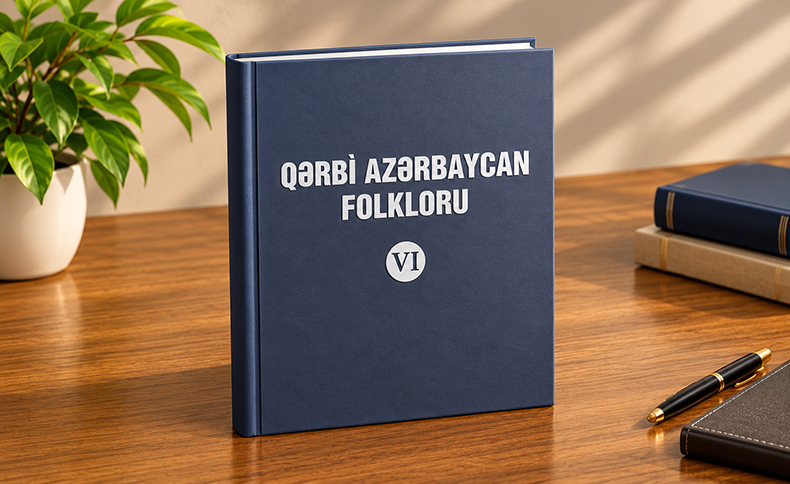
Volume VI of the Multi-Volume Collection “Folklore of Western Azerbaijan” Published at the Institute of Folklore
As part of the ongoing scholarly work at the Institute of Folklore of the Azerbaijan National Academy of Sciences (ANAS) on collecting, compiling and publishing the folklore of Western Azerbaijan, Volume VI of the multi-volume collection Folklore of Western Azerbaijan has been published.
The 370-page book was published by the decision of the Scientific Council of the ANAS Institute of Folklore. The project is headed by Hikmat Guliyev, Doctor of Sciences in Philology and Associate Professor. The compilers and authors of the preface are Doctor of Philosophy in Philology and Associate Professor Atash Ahmadli, Doctor of Philosophy in Philology and Associate Professor Elchin Abbasov and Doctor of Philosophy in Philology Dadash Aliyev. The scientific editor of the volume is Doctor of Philosophy in Philology and Associate Professor Aziz Alakbarli.
The publication features folklore materials and ethnographic information collected from Western Azerbaijanis who settled in the Goychay and Ismayilli districts following the deportations of 1948–1953 and 1988. The book’s primary objective is to systematize and introduce into scholarly circulation materials reflecting the historical memory, oral traditions, linguistic characteristics and everyday culture of the population of Western Azerbaijan.
The preface characterizes the folklore of Western Azerbaijan as an important source reflecting the people’s historical experience, ethno-psychological characteristics, worldview, customs and traditions, beliefs and everyday life. Particular attention is given to the memories of families displaced from their ancestral homes, the hardships caused by the deportations, the challenges they faced in their new places of residence and their lived experiences.
The volume also devotes considerable attention to the ashiq tradition of Western Azerbaijan and the works of folk poets. These examples highlight the interaction between individual creativity and collective folklore traditions, the artistic expression of longing for one’s homeland, and the preservation of the ashiq-poetic heritage.
These materials demonstrate that national cuisine is not merely a set of food practices but also reflects everyday life, local knowledge and the transmission of cultural heritage from one generation to the next.
Another feature that enhances the scholarly value of the publication is the attention paid to documenting source information during the collection and presentation of folklore texts. The codes provided at the end of the texts are linked to information about the narrators and collectors.
Volume VI of Folklore of Western Azerbaijan is a valuable source for research in folklore studies, ethnography, dialectology, ashiq literature and the history of national cuisine. By revealing the richness of genres, regional characteristics, and connections with historical memory in Western Azerbaijani folklore, the publication also carries considerable scholarly and cultural significance for collecting, preserving and transmitting intangible oral heritage to future generations.