
NEWS
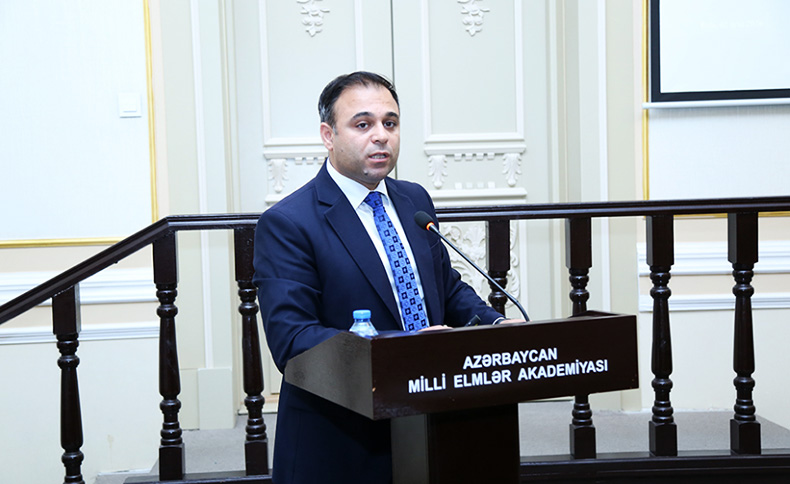
Director of the Institute of Folklore made a presentation on the theme “The Conceptual Foundations and Development Prospects of Digital Turkic Folklore Studies”
Within the framework of the Turkic World Week dedicated to the 100th anniversary of the First Turkology Congress, the panel “Digital Turkology” organized at the Azerbaijan National Academy of Sciences (ANAS), featured a presentation by Doctor of Sciences in Philology, Director of the Institute of Folklore of ANAS Hikmat Guliyev. His presentation was entitled “The Conceptual Foundations and Development Prospects of Digital Turkic Folklore Studies”.
In his presentation H.Guliyev described the centenary of the First Turkology Congress as an important scholarly platform for reassessing the theoretical and methodological directions of Turkology in its second century. He noted that the First Turkology Congress, held in Baku in 1926, was not merely a forum for discussing the issue of a common alphabet. Rather, it served as a multidisciplinary intellectual platform that brought together the study of the languages, history, folklore, ethnography, literature and other fields of the humanities relating to the Turkic peoples within a unified scholarly framework.
A central focus of the presentation was the conceptual framework of digital Turkic folklore studies. It was mentioned that this approach extends far beyond the digitization of folklore materials or the study of internet folklore. Instead, it aims to establish new methodological principles for the production of Turkological knowledge in the era of digital transformation, promote the study of folklore heritage through contemporary analytical tools and develop new models of scholarly cooperation within Turkology.
The presentation also highlighted the importance of creating shared digital folklore corpora, open-access databases, a unified terminological system, semantic networks, and digital platforms for scholarly collaboration across the Turkic world. It was noted that the development of a digital knowledge ecosystem based on common methodological principles is of strategic importance for the future advancement of Turkological research.
In conclusion, H. Guliyev mentioned that if the First Turkological Congress played a decisive role in fostering a common scholarly vision and a culture of cooperation across the Turkic world during the twentieth century, one of the key tasks of the digital transformation era was to further develop this tradition through modern technological opportunities and to establish new organizational and methodological models for the production of Turkological knowledge.