
NEWS
Hikmat Guliyev: “Investigating new scientific problems in Azerbaijani folklore studies is a requirement of global challenges and national priorities”
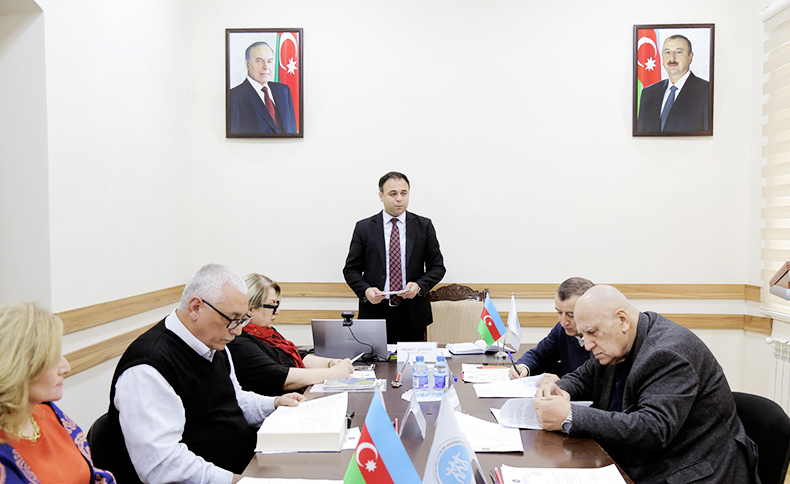
These words were told by Hikmat Guliyev, Director of the Folklore Institute of the Azerbaijan National Academy of Sciences (ANAS), Doctor of Sciences in Philology, during a meeting of the Academic Council of the Institute. He noted that global transformations in the modern era, the priorities of state policy implemented in the country and recent reforms carried out within ANAS in the fields of humanities and social sciences are shaping new tasks for folklore studies.
Hikmat Guliyev mentioned that in recent years a number of steps had been taken to move Azerbaijani folklore studies beyond the framework of classical philological and historical paradigms toward methodological approaches that examine socio-cultural dynamics and collective responses. The research problems addressed for the period 2021–2025 had been thoroughly analyzed and the objectives for the next stage had been identified.
Starting from 2026 it is planned that the scientific direction of the ANAS Folklore Institute will be based on the concept of studying Azerbaijani folklore as a living communicative system in the context of collective cultural memory, national identity, traditional thinking, and social stereotypes – focusing on its essence, function and structure.
For the period 2026-2030 the main goal of Azerbaijani folklore studies is both to preserve national cultural heritage and to ensure its integration into global academic discourse. Within this framework, priority research areas have been identified, including the study of collective cultural memory and stereotypical worldviews; the socio-psychological essence of folklore; analysis of its ritual-performative and communicative nature; investigation of historical-cultural heritage and multicultural folklore environments; as well as the relationship between folklore and socio-technological platforms, artificial intelligence and the systematic analysis of folklore examples across professional and social groups.