
NEWS
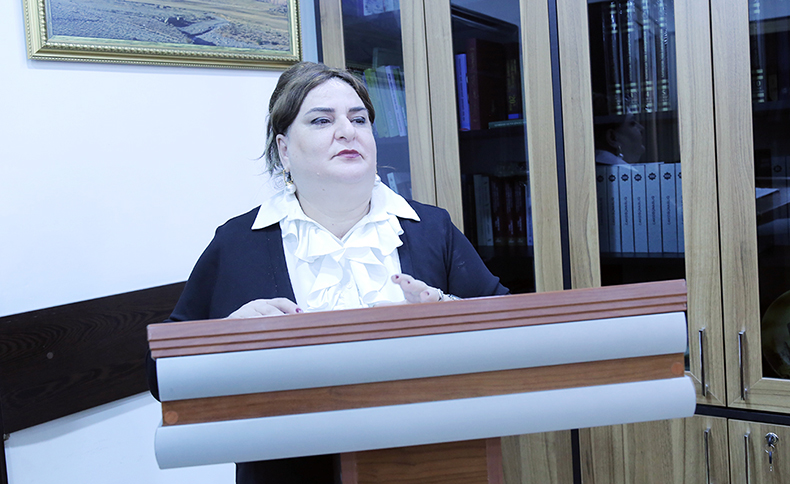
Head of the Department of South Azerbaijan Folklore of the Institute of Folklore of ANAS, Doctor of Sciences in Philology, Matanat Abbasova: “Language is the national identity and national character of the people to which it belongs and at the same time, its historical path and destiny”
In the philosophical approach the language, which is a form of social consciousness, is the national identity and national character of the people to which it belongs, as well as its historical path and destiny. In this respect, the Azerbaijani language, with its rich cultural heritage, has undergone various political and social events in its historical destiny, has been subjected to pressure from time to time and has not escaped attacks and influences on the language.
In this respect, the Arabic-Persian and Russian words that occupy a large place in the vocabulary of our language, as well as the expressions of European origin that pass through the Russian language, are also the past of the people, which tells us about their past. In today’s globalized world, the purity of language and the purity of speech have become particularly relevant, bringing to the agenda the protection of the conceptual core of the language. The language policy pursued by the former National Leader Heydar Aliyev, in this context, has had an impact on the quality and standardization of the language by preventing “artificial innovations”. Today, in the conditions of rapid changes in the new era - the complexity of various political and social processes, the clash of cultures, the disruption of the ecological balance, and activity on social networks are having an impact on the language from the point of view of modernization.
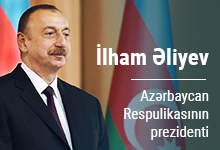
President Ilham Aliyev’s consistent and principled policy towards the purity and protection of the Azerbaijani literary language stems from the preservation of the quality of our language, its development at the expense of internal resources, taking into account modernity, and care for our cultural wealth and heritage. The demands put forward by the President at the solemn meeting dedicated to the 80th anniversary of ANAS to strengthen care and control over our language once again placed this problem as a task for intellectuals and researchers in the humanitarian field.
The demands set by the President for the protection and purification of our language actually imply the joint work not only of linguists working in this field, but also of historians, folklorists, ethnographers, journalists and specialists in other fields. In this regard, the study of language problems, the study of the folklore heritage from which the literary language originates, the preservation of the originality of our dialects and dialects in texts and others have once again brought opportunities to the agenda.
The content of the folklore-linguistic landscape of world is determined by the specificity of its structural organization, the conceptual sphere of folklore, which is conditioned by socio-historical trends, and shows the indirect influence of the socio-cultural factor on the folklore language.
By the way, it is necessary to note that a comprehensive approach to the purification and preservation of the language also means the purification of speech from a cultural perspective. A language that is free from foreign words, expressions and elements also influences the content of effective communication. Language also carries the burden of social experience and in this regard, eliminating elements that are not essential for communication is also among the principles of language purification. Today, the demands put forward by the country’s leader regarding the preservation of the purity of our language once again remind each of us of our civic position, our sacred duty and the duty to fulfill it.