
NEWS
Hikmat Guliyev: The Ideas of the First Turkological Congress Continue to Foster the Scientific and Cultural Integration of the Turkic World
The First Turkological Congress, held in Baku in 1926, was a landmark scholarly and cultural event that brought together Turkologists from different parts of the world on a common intellectual platform for the first time.
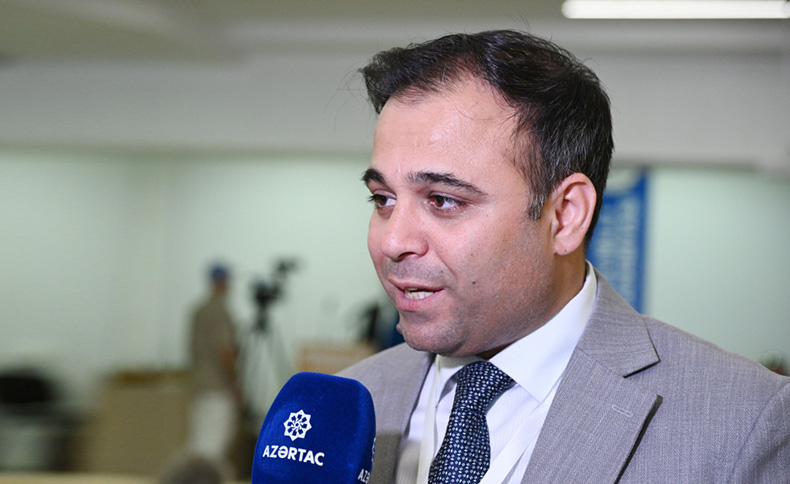
These remarks were made by Director of the Institute of Folklore of the Azerbaijan National Academy of Sciences (ANAS), Doctor of Sciences in Philology Hikmat Guliyev in an interview with AZERTAC.
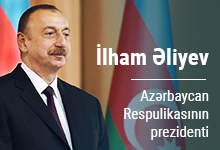
Hikmat Guliyev mentioned that President Ilham Aliyev’s statement during his inauguration ceremony on February 14, 2024 “We have no other family. Our family is the Turkic world” along with the presidential decree commemorating the 100th anniversary of the First Turkological Congress, has provided a strong political foundation for initiatives in this field. He noted that the events held across Azerbaijan to mark the centenary of the Congress serve to carry the shared values inherited from the common Turkic past into the common Turkic future.
According to Hikmat Guliyev, the international symposium, jointly organized by the Azerbaijan National Academy of Sciences, the ANAS Institute of Folklore, the Azerbaijan National Commission for UNESCO, the Turkic Culture and Heritage Foundation, Hajettepe University of Türkiye and other partner institutions, is a continuation of these ideals. In addition to Azerbaijani scholars, the symposium has brought together researchers from Kazakhstan, Kyrgyzstan, Türkiye, Uzbekistan, Turkmenistan and several other countries. Within the framework of the event, 12 panel sessions are being held to discuss methodological and terminological issues in Turkology and folklore studies, as well as the study, preservation, transmission of the common Turkic heritage to future generations.
The Director also noted that discussions held with the participation of UNESCO representatives focus on such contemporary issues as safeguarding intangible cultural heritage, the challenges of globalization and preserving national and spiritual values in the era of digitalization and artificial intelligence.