
NEWS
The proceedings of the Republican scientific conference on the topic “National Statehood and Folklore” have been published at the Institute of Folklore
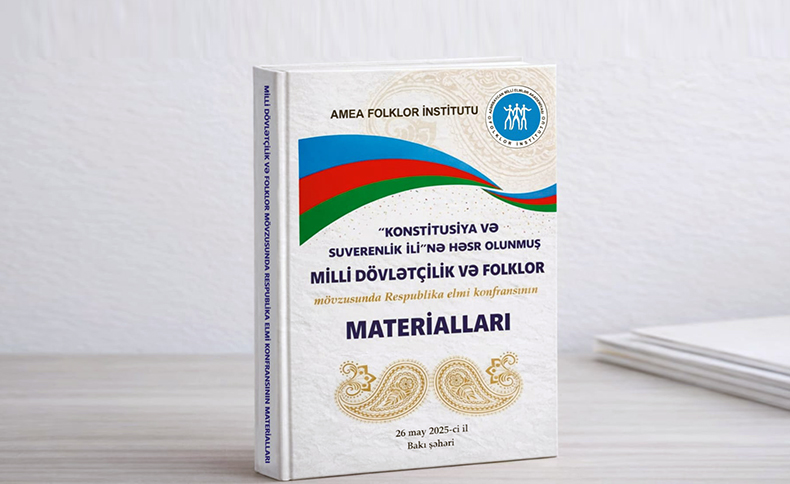
The proceedings of the Republican scientific conference on the topic “National Statehood and Folklore,” organized by the Institute of Folklore of ANAS, have been published.
The collection brings together a total of 51 papers by scholars and researchers representing various scientific and higher education institutions of the republic. The publication examines the folklore sources of the idea of national statehood, analyzes the images of power and the ruler in the epic tradition, and systematically interprets the ideas of national identity and freedom in folklore. At the same time, mythological worldview, ritual and festive culture, ashiq activity, the directions of transformation of modern folklore and the theoretical paradigms of folklore studies in the period of independence are presented within a scholarly framework.
In the book the historical and cultural foundations of the concept of statehood based on the epic heritage of Turkic peoples are identified and the semantics of the notions of sovereignty and national unity in folkloric memory are explained. It substantiates, with scholarly arguments, the place of religious and moral values, the reflection of constitutional provisions in Azerbaijani folklore, and the role of Nowruz and Ramadan rituals within the national-spiritual system. It also addresses issues related to the restoration of ceremonial traditions in the territories liberated from occupation.
It should be noted that the conference proceedings, consisting of 432 pages, were published by the publishing house “Science and Education”. The scientific editor of the book is Doctor of Sciences in Philology Hikmat Guliyev, while the compilers are PhD in Philology, Associate Professor Sakina Gaybaliyeva and PhD in Philology, Associate Professor Elnara Huseyngizi-Amirli. The technical editor is PhD in Philology, Associate Professor Aynura Safarova.
By following the link, one can access the electronic version of the book.